Books |
Collection of Samuel Krauss
Author:
Markus Stumpf
Markus Stumpf
“The times have changed enormously, but I think that even a Jew, at least this Jew, may be allowed to approach you, at least on a purely academic matter.”
Issues of the Monatsschrift für Geschichte und Wissenschaft des Judentums owned by Samuel Krauss at the University of Vienna Library1
The Monatsschrift für Geschichte und Wissenschaft des Judentums, mouthpiece of the Gesellschaft zur Förderung der Wissenschaft des Judentums [Association for the Promotion of Judaic Studies] was founded in 1851 by rabbi Zacharias Frankel (1801–1875) in Dresden. It served as an outlet for the positive historical school of Judaism founded by him. This school was positioned between the reform and the new orthodox movements: conservative in terms of religion and belief but more critical when it came to historical research. The magazine also served for the promotion of Judaic studies, as the association’s name indicates. It was forced to cease publication in 1939.2
As one of the main journals on Judaic studies, it was collected by the Jewish scholar Samuel Krauss (1866–1948). Krauss was born in Ukk, Hungary. He attended the rabbinical seminar and the University of Budapest. After studying further in Berlin, Giessen (doctorate in 1893) and Budapest, he became a lecturer in Bible studies, history and liturgy at the Jewish Theological Institute (ITLA) in Vienna in 1906 and was its director from 1932 and rector from 1937.3 The ITLA was the training college for rabbis and Jewish religion teachers in Vienna from 1893 to 1938.4
Krauss’s extensive academic œuvre is impressively demonstrated by his 1937 bibliography listing over 1,300 papers. Apart from 34 books and 325 lemma in encyclopædias, there are also 956 essays and reviews.5 Chief rabbi David Feuchtwang (1864–1936) rightly pointed out on the occasion of Krauss’s seventieth birthday that “he [can] look back on forty-five years of academic scholarship covering all aspects and periods of the huge area of Jewish studies.”6 After the annexation of Austria to the German Reich, Krauss was persecuted as a Jew under the Nuremberg Laws.
back
Issues of the Monatsschrift für Geschichte und Wissenschaft des Judentums owned by Samuel Krauss at the University of Vienna Library1
The Monatsschrift für Geschichte und Wissenschaft des Judentums, mouthpiece of the Gesellschaft zur Förderung der Wissenschaft des Judentums [Association for the Promotion of Judaic Studies] was founded in 1851 by rabbi Zacharias Frankel (1801–1875) in Dresden. It served as an outlet for the positive historical school of Judaism founded by him. This school was positioned between the reform and the new orthodox movements: conservative in terms of religion and belief but more critical when it came to historical research. The magazine also served for the promotion of Judaic studies, as the association’s name indicates. It was forced to cease publication in 1939.2
As one of the main journals on Judaic studies, it was collected by the Jewish scholar Samuel Krauss (1866–1948). Krauss was born in Ukk, Hungary. He attended the rabbinical seminar and the University of Budapest. After studying further in Berlin, Giessen (doctorate in 1893) and Budapest, he became a lecturer in Bible studies, history and liturgy at the Jewish Theological Institute (ITLA) in Vienna in 1906 and was its director from 1932 and rector from 1937.3 The ITLA was the training college for rabbis and Jewish religion teachers in Vienna from 1893 to 1938.4
Krauss’s extensive academic œuvre is impressively demonstrated by his 1937 bibliography listing over 1,300 papers. Apart from 34 books and 325 lemma in encyclopædias, there are also 956 essays and reviews.5 Chief rabbi David Feuchtwang (1864–1936) rightly pointed out on the occasion of Krauss’s seventieth birthday that “he [can] look back on forty-five years of academic scholarship covering all aspects and periods of the huge area of Jewish studies.”6 After the annexation of Austria to the German Reich, Krauss was persecuted as a Jew under the Nuremberg Laws.
1 This essay is a revised and modified version of a chapter in the paper by Christina Köstner-Pemsel and Markus Stumpf, “‘Machen Sie es ordentlich, damit man nachher, wenn wir die Bücher ihren Besitzern zurückgeben, nicht sagt, es hätten Schweine in der Hand gehabt’: Die Orientalistik – Ergebnisse der Provenienzforschung an der Universitätsbibliothek Wien”, in Mitteilungen der VÖB 65 (2012) no. 1, pp. 39–78, http://eprints.rclis.org/17180/.
2 Andreas Brämer, “‘Die Anfangsjahre der Monatsschrift für die Geschichte und Wissenschaft des Judentums (1851– 1868): Kritische Forschung und jüdische Tradition im Zeitalter der Emanzipation”, in Michael Nagel, ed., Zwischen Selbstbehauptung und Verfolgung: deutsch-jüdische Zeitungen und Zeitschriften von der Aufklärung bis zum Nationalsozialismus (Hildesheim/Zurich/New York 2002) (= HASKALA Wissenschaftliche Abhandlungen 25), pp. 139– 59.
3 Susanne Blumesberger, Michael Doppelhofer, Gabriele Mauthe, Handbuch österreichischer Autorinnen und Autoren jüdischer Herkunft: 18. bis 20. Jahrhundert (Berlin/Boston 2011), vol. 2, p. 744; Österreichisches Biographisches Lexikon (ÖBL) 1815–1950, vol. 4 (Lfg. 18, 1968), p. 234. http://biographien.ac.at/oebl/oebl_K/Krauss_Samuel_1866_1948.xml.
4 For the history of the ITLA, see Peter Landesmann, “Die Geschichte der Ausbildung von Rabbinern in Wien bis zur Gründung der Israelitisch-Theologischen Lehranstalt (ITLA)”, in Frank Stern, Barbara Eichinger, eds, Wien und die jüdische Erfahrung 1900–1938: Akkulturation – Antisemitismus – Zionismus (Vienna/Cologne/Weimar 2009), pp. 143– 53, here pp. 151–53; see also the website of the IKG archive http://www.archiv-ikg-wien.at/archives/institutionen/? tab=1716&topic=1971.
5 Eli Strauss, Bibliographie der Schriften Prof. Dr. Samuel Krauss’ 1887–1937, published by the Festkomitee zur Feier seines 70. Geburtstages (Vienna 1937).
6 David Feuchtwang, “Geleitwort”, in Strauss, Bibliographie, p. 1.
2 Andreas Brämer, “‘Die Anfangsjahre der Monatsschrift für die Geschichte und Wissenschaft des Judentums (1851– 1868): Kritische Forschung und jüdische Tradition im Zeitalter der Emanzipation”, in Michael Nagel, ed., Zwischen Selbstbehauptung und Verfolgung: deutsch-jüdische Zeitungen und Zeitschriften von der Aufklärung bis zum Nationalsozialismus (Hildesheim/Zurich/New York 2002) (= HASKALA Wissenschaftliche Abhandlungen 25), pp. 139– 59.
3 Susanne Blumesberger, Michael Doppelhofer, Gabriele Mauthe, Handbuch österreichischer Autorinnen und Autoren jüdischer Herkunft: 18. bis 20. Jahrhundert (Berlin/Boston 2011), vol. 2, p. 744; Österreichisches Biographisches Lexikon (ÖBL) 1815–1950, vol. 4 (Lfg. 18, 1968), p. 234. http://biographien.ac.at/oebl/oebl_K/Krauss_Samuel_1866_1948.xml.
4 For the history of the ITLA, see Peter Landesmann, “Die Geschichte der Ausbildung von Rabbinern in Wien bis zur Gründung der Israelitisch-Theologischen Lehranstalt (ITLA)”, in Frank Stern, Barbara Eichinger, eds, Wien und die jüdische Erfahrung 1900–1938: Akkulturation – Antisemitismus – Zionismus (Vienna/Cologne/Weimar 2009), pp. 143– 53, here pp. 151–53; see also the website of the IKG archive http://www.archiv-ikg-wien.at/archives/institutionen/? tab=1716&topic=1971.
5 Eli Strauss, Bibliographie der Schriften Prof. Dr. Samuel Krauss’ 1887–1937, published by the Festkomitee zur Feier seines 70. Geburtstages (Vienna 1937).
6 David Feuchtwang, “Geleitwort”, in Strauss, Bibliographie, p. 1.
back
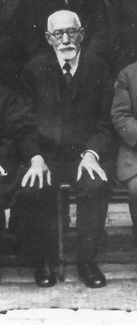
Principal Professor Doctor Samuel Krauss, Detail of a photograph in front of the ITLA, 1934/35 © Norbert N. Kristianpoller