Books |
Collection of Samuel Krauss
Author:
Markus Stumpf
Markus Stumpf
Nazi provenance research at the Vienna University Library
As a consequence of the 2002 Universities Act, books in the Vienna University Library published before 1800 would remain the property of the State, while those published thereafter would be transferred to the University of Vienna.
Although the Art Restitution Act23 initially applied only to federal museums and the Austrian National Library, Nazi provenance research began at the Vienna University Library in 2004 as in the federal institutions with a view to achieving a “fair and just solution” as specified in the 1998 Washington Principles. It was not until the 2009 amendment to the Art Restitution Act that provenance research was extended to all State collections and the remaining items owned by the State became the concern of the Commission for Provenance Research and Art Restitution Advisory Board.
The provenance research at the Vienna University Library24 established that at least 8,014 books and a stone with a cuneiform inscription were taken over by the Department of Near Eastern Studies. They included works from the Burgenland Jewish communities, the Central Office for Jewish Emigration, and the library of the Munich lawyer and publisher Ludwig Feuchtwanger (1885–1947). It may be assumed, however, that not all of the problematic books accepted by the Department have been documented to date.
At all events, Kurt Schubert (1923–2007), a student and later founder of the Department of Jewish Studies at the University of Vienna, handed over forty-four boxes25 containing around 20,000 books to the IKG from the Department of Near Eastern Studies.26 Most of the books were from the ITLA that Schubert had brought to the Department during the Nazi period from the basement in Tempelgasse but not classed as a loan from the SS-Ahnenerbe. There must also have been Ahnenerbe books, however. This is certainly true of the books from Samuel Krauss, while Feuchtwanger’s library, called “loan A”, was kept and not returned to the heirs until 1956, with a supplementary list in 2012.27 In the immediate post-war period, it would appear that no one was interested in “loan B” and its identification as having belonged to Krauss. Many of the books handed to the IKG were later transferred to Israel.
Because the expropriated library was probably transported to Berlin in the Nazi period, the Krauss family sought after the war to obtain compensation. A small amount was finally granted by the Berlin district court in 1977 after proceedings lasting twenty years.28 It was not until the discovery of the files in the course of the Nazi provenance research that the former owner of “loan B” was identified.29 In 2011 it was listed as being worthy of research,30 and – under improved research conditions – the missing data was finally provided in 2012.31
The seven bound volumes and fourteen separate issues of the journal have now been identified as having belonged to Samuel Krauss on the basis of the letter “B” stamped on the label. They are also included in the list of books stolen from Krauss that went to the Department of Near Eastern Studies.
On the labels of the duplicate volumes in the Jewish Studies library is not only the letter “B” but also a provenance mark indicating that they came from the IKG library.33 These are not books stolen from the IKG library but items given to the IKG in 1945 and donated by it in 1994 to the Department of Jewish Studies, as can be seen from an acknowledgement list in the year 2000 with the heading “books from the IKG to the Department of Jewish Studies”.34
As a consequence of the 2012 publication, a further volume of “loan B” coming from Samuel Krauss was found in the Austrian Academy of Sciences in 2013, no doubt from Viktor Christian. It was handed over to the Vienna University Library for restitution. The list of Samuel Krauss’s books taken by the Department of Near Eastern Studies contains an item entitled “Lexikographie v. Samuel Krauss”. This volume in fact contains five special issues,35 four from Samuel Krauss from his personal library bound together with numerous handwritten notes.36 It is thus one of the few surviving documents in which some of his scholarship and method of working can still be seen.37
In 2014 the two print items were restituted to the heirs, who then graciously donated them to the Vienna University Library as a “permanent loan from the Krauss family”. They are now in the Department of Jewish Studies library and listed accordingly in the catalogue and long-term repository.
The Nazi provenance research at the Vienna University Library thus makes a positive contribution to the memory of the victims of the Nazi regime and is part of the diverse research and commemoration projects on the history of the University of Vienna and on the Nazi period.
Markus Stumpf, Provenienzforscher und Leiter der Fachbereichsbibliothek Zeitgeschichte
back
As a consequence of the 2002 Universities Act, books in the Vienna University Library published before 1800 would remain the property of the State, while those published thereafter would be transferred to the University of Vienna.
Although the Art Restitution Act23 initially applied only to federal museums and the Austrian National Library, Nazi provenance research began at the Vienna University Library in 2004 as in the federal institutions with a view to achieving a “fair and just solution” as specified in the 1998 Washington Principles. It was not until the 2009 amendment to the Art Restitution Act that provenance research was extended to all State collections and the remaining items owned by the State became the concern of the Commission for Provenance Research and Art Restitution Advisory Board.
The provenance research at the Vienna University Library24 established that at least 8,014 books and a stone with a cuneiform inscription were taken over by the Department of Near Eastern Studies. They included works from the Burgenland Jewish communities, the Central Office for Jewish Emigration, and the library of the Munich lawyer and publisher Ludwig Feuchtwanger (1885–1947). It may be assumed, however, that not all of the problematic books accepted by the Department have been documented to date.
At all events, Kurt Schubert (1923–2007), a student and later founder of the Department of Jewish Studies at the University of Vienna, handed over forty-four boxes25 containing around 20,000 books to the IKG from the Department of Near Eastern Studies.26 Most of the books were from the ITLA that Schubert had brought to the Department during the Nazi period from the basement in Tempelgasse but not classed as a loan from the SS-Ahnenerbe. There must also have been Ahnenerbe books, however. This is certainly true of the books from Samuel Krauss, while Feuchtwanger’s library, called “loan A”, was kept and not returned to the heirs until 1956, with a supplementary list in 2012.27 In the immediate post-war period, it would appear that no one was interested in “loan B” and its identification as having belonged to Krauss. Many of the books handed to the IKG were later transferred to Israel.
Because the expropriated library was probably transported to Berlin in the Nazi period, the Krauss family sought after the war to obtain compensation. A small amount was finally granted by the Berlin district court in 1977 after proceedings lasting twenty years.28 It was not until the discovery of the files in the course of the Nazi provenance research that the former owner of “loan B” was identified.29 In 2011 it was listed as being worthy of research,30 and – under improved research conditions – the missing data was finally provided in 2012.31
The seven bound volumes and fourteen separate issues of the journal have now been identified as having belonged to Samuel Krauss on the basis of the letter “B” stamped on the label. They are also included in the list of books stolen from Krauss that went to the Department of Near Eastern Studies.
On the labels of the duplicate volumes in the Jewish Studies library is not only the letter “B” but also a provenance mark indicating that they came from the IKG library.33 These are not books stolen from the IKG library but items given to the IKG in 1945 and donated by it in 1994 to the Department of Jewish Studies, as can be seen from an acknowledgement list in the year 2000 with the heading “books from the IKG to the Department of Jewish Studies”.34
As a consequence of the 2012 publication, a further volume of “loan B” coming from Samuel Krauss was found in the Austrian Academy of Sciences in 2013, no doubt from Viktor Christian. It was handed over to the Vienna University Library for restitution. The list of Samuel Krauss’s books taken by the Department of Near Eastern Studies contains an item entitled “Lexikographie v. Samuel Krauss”. This volume in fact contains five special issues,35 four from Samuel Krauss from his personal library bound together with numerous handwritten notes.36 It is thus one of the few surviving documents in which some of his scholarship and method of working can still be seen.37
In 2014 the two print items were restituted to the heirs, who then graciously donated them to the Vienna University Library as a “permanent loan from the Krauss family”. They are now in the Department of Jewish Studies library and listed accordingly in the catalogue and long-term repository.
The Nazi provenance research at the Vienna University Library thus makes a positive contribution to the memory of the victims of the Nazi regime and is part of the diverse research and commemoration projects on the history of the University of Vienna and on the Nazi period.
Markus Stumpf, Provenienzforscher und Leiter der Fachbereichsbibliothek Zeitgeschichte
Markus Stumpf, Provenance researcher and Head of the Department of Modern History Library
23 BGBl. no. I, 181/1998.
24 https://bibliothek.univie.ac.at/provenienzforschung.html.
25 Zechner, “Bibliothek”, pp. 82–103, here p. 89.
26 Evelyn Adunka, Die vierte Gemeinde (Berlin/Vienna 2000), p. 305; the various sources cite different numbers and provenances of the books.
27 Stumpf, “Ergebnisse der Provenienzforschung an der Fachbereichsbibliothek Judaistik der Universität Wien”, in Bruno Bauer, Christina Köstner-Pemsel, Markus Stumpf, eds, NS-Provenienzforschung an österreichischen Bibliotheken: Anspruch und Wirklichkeit (Graz-Feldkirch 2011) (= Schriften der Vereinigung Österreichischer Bibliothekarinnen und Bibliothekare 10), pp. 155–88, here pp. 164–76.
28 Evelyn Adunka, Raub, pp. 225–32.
29 The Ahnenerbe portfolio was handed over by the Department of Near Eastern Studies to the Nazi provenance research at the Vienna University Library in 2006 and to the archive of the University of Vienna on 11 September 2012, where it was incorporated in the Near Eastern Studies holdings.
30 Markus Stumpf, “Ergebnisse”, pp. 155–88, here p. 183.
31 Köstner-Pemsel, “Machen Sie es ordentlich”, pp. 39–78.
32 Markus Stumpf, “Ergebnisse”, pp. 155–88, here pp. 182–83.
33 Evelyn Adunka, Raub, pp. 71–81; Zechner, “Bibliothek”, pp. 82–103, 84–88.
34 Department of Jewish Studies, list of books transferred from the library of the Jewish Museum Vienna to the Department of Jewish Studies from the (former) holdings of the IKG, compiled by Domagoj Akrap, 2000.
35 It contains the following special issues: Samuel Krauss, “Zur Griechischen und Lateinischen Lexikographie aus jüdischen Quellen” special reprint from Byzantinische Zeitschrift 2.1893”, pp. 493–548, https://ubdata.univie.ac.at/AC05885834; Samuel Krauss, “Zur Erklärung der tiburtinischen Sibylle”, special reprint from Byzantinische Zeitschrift 9.1900”, pp. 200–3, https://ubdata.univie.ac.at/AC11569815; Samuel Krauss, “Die Königin von Saba in den byzantinischen Chroniken”, special reprint from Byzantinische Zeitschrift 11.1902”, pp 120–31, https://ubdata.univie.ac.at/AC11569840; Ernst Gerland, “Die persischen Feldzüge des Kaisers Herakleios”, special reprint from Byzantinische Zeitschrift 2.1893, pp. 330–73, https://ubdata.univie.ac.at/AC11569869; Samuel Krauss, “Bad und Badewesen im Talmud”, special reprint from Hakedem: Vierteljahresschrift für die Kunde des alten Orients und die Wissenschaft des Judentums, 1.1907/no. 3, S. 87–110 and no. 4, pp. 171–94, 2.1908, no. 1/2, pp. 32–50 with own pagination pp. 1–65 and additional correction of printing errors, https://ubdata.univie.ac.at/AC11569894.
36 The special reprints in this volume with annotations by Krauss have been digitized and are available for research as “Sammlung Samuel Krauss” in the Langzeitrepositorium of the University of Vienna, https://phaidra.univie.ac.at/detail/o:1539040.
37 Part of the estate of Samuel Krauss is in the University of Southampton Special Collections (Papers of Samuel Krauss/GB 738 MS 163); most of this estate refers to his time in exile.
24 https://bibliothek.univie.ac.at/provenienzforschung.html.
25 Zechner, “Bibliothek”, pp. 82–103, here p. 89.
26 Evelyn Adunka, Die vierte Gemeinde (Berlin/Vienna 2000), p. 305; the various sources cite different numbers and provenances of the books.
27 Stumpf, “Ergebnisse der Provenienzforschung an der Fachbereichsbibliothek Judaistik der Universität Wien”, in Bruno Bauer, Christina Köstner-Pemsel, Markus Stumpf, eds, NS-Provenienzforschung an österreichischen Bibliotheken: Anspruch und Wirklichkeit (Graz-Feldkirch 2011) (= Schriften der Vereinigung Österreichischer Bibliothekarinnen und Bibliothekare 10), pp. 155–88, here pp. 164–76.
28 Evelyn Adunka, Raub, pp. 225–32.
29 The Ahnenerbe portfolio was handed over by the Department of Near Eastern Studies to the Nazi provenance research at the Vienna University Library in 2006 and to the archive of the University of Vienna on 11 September 2012, where it was incorporated in the Near Eastern Studies holdings.
30 Markus Stumpf, “Ergebnisse”, pp. 155–88, here p. 183.
31 Köstner-Pemsel, “Machen Sie es ordentlich”, pp. 39–78.
32 Markus Stumpf, “Ergebnisse”, pp. 155–88, here pp. 182–83.
33 Evelyn Adunka, Raub, pp. 71–81; Zechner, “Bibliothek”, pp. 82–103, 84–88.
34 Department of Jewish Studies, list of books transferred from the library of the Jewish Museum Vienna to the Department of Jewish Studies from the (former) holdings of the IKG, compiled by Domagoj Akrap, 2000.
35 It contains the following special issues: Samuel Krauss, “Zur Griechischen und Lateinischen Lexikographie aus jüdischen Quellen” special reprint from Byzantinische Zeitschrift 2.1893”, pp. 493–548, https://ubdata.univie.ac.at/AC05885834; Samuel Krauss, “Zur Erklärung der tiburtinischen Sibylle”, special reprint from Byzantinische Zeitschrift 9.1900”, pp. 200–3, https://ubdata.univie.ac.at/AC11569815; Samuel Krauss, “Die Königin von Saba in den byzantinischen Chroniken”, special reprint from Byzantinische Zeitschrift 11.1902”, pp 120–31, https://ubdata.univie.ac.at/AC11569840; Ernst Gerland, “Die persischen Feldzüge des Kaisers Herakleios”, special reprint from Byzantinische Zeitschrift 2.1893, pp. 330–73, https://ubdata.univie.ac.at/AC11569869; Samuel Krauss, “Bad und Badewesen im Talmud”, special reprint from Hakedem: Vierteljahresschrift für die Kunde des alten Orients und die Wissenschaft des Judentums, 1.1907/no. 3, S. 87–110 and no. 4, pp. 171–94, 2.1908, no. 1/2, pp. 32–50 with own pagination pp. 1–65 and additional correction of printing errors, https://ubdata.univie.ac.at/AC11569894.
36 The special reprints in this volume with annotations by Krauss have been digitized and are available for research as “Sammlung Samuel Krauss” in the Langzeitrepositorium of the University of Vienna, https://phaidra.univie.ac.at/detail/o:1539040.
37 Part of the estate of Samuel Krauss is in the University of Southampton Special Collections (Papers of Samuel Krauss/GB 738 MS 163); most of this estate refers to his time in exile.
back

Excerpt from the list with number of copies, title and year, of works from the library of Samuel Krauss handed over by the Gestapo to the Oriental Institute of the University of Vienna © Vienna University Library
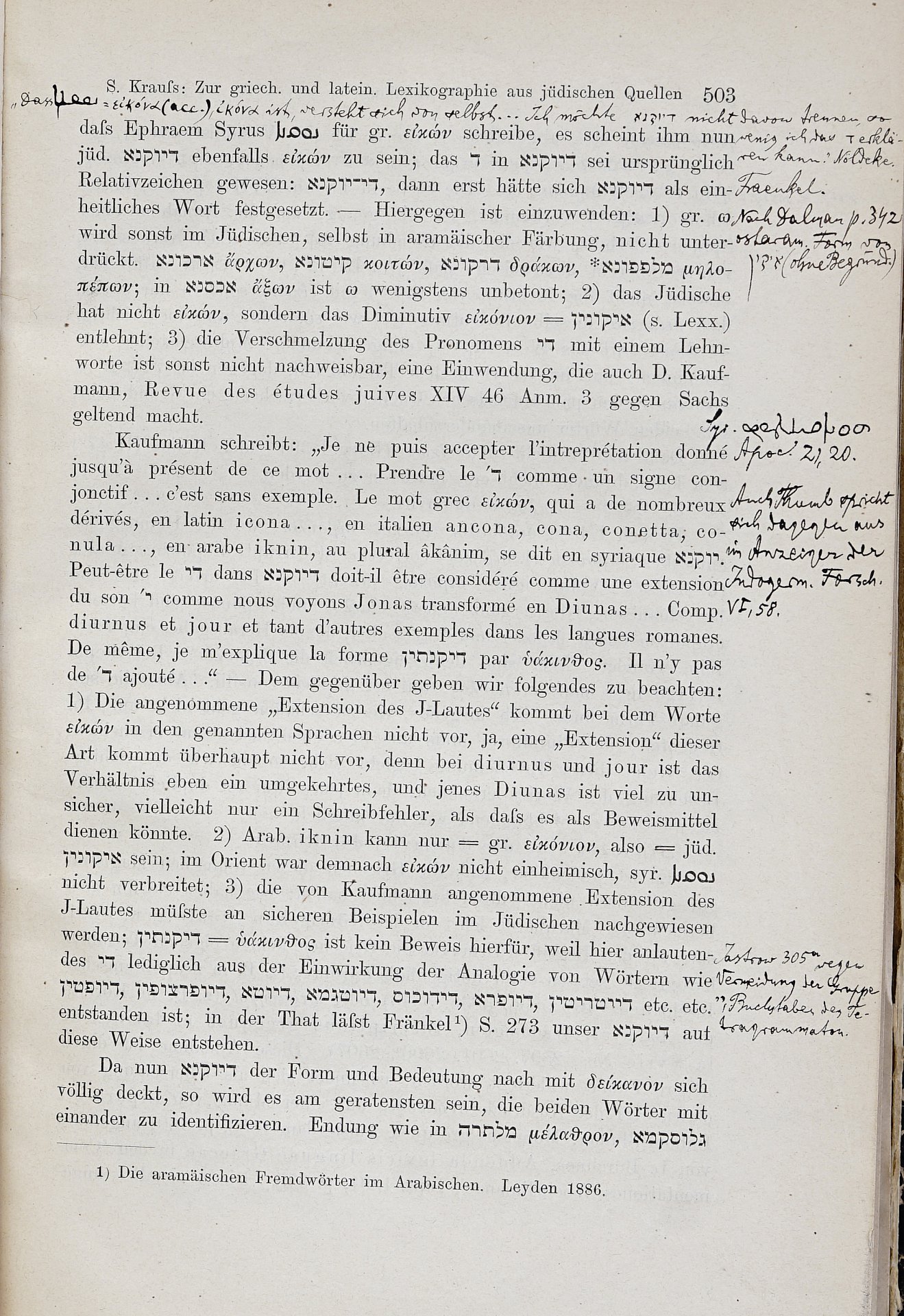
Annotations by Samuel Krauss in his offprint "On Greek and Latin Lexicography from Jewish Sources" © Markus Stumpf
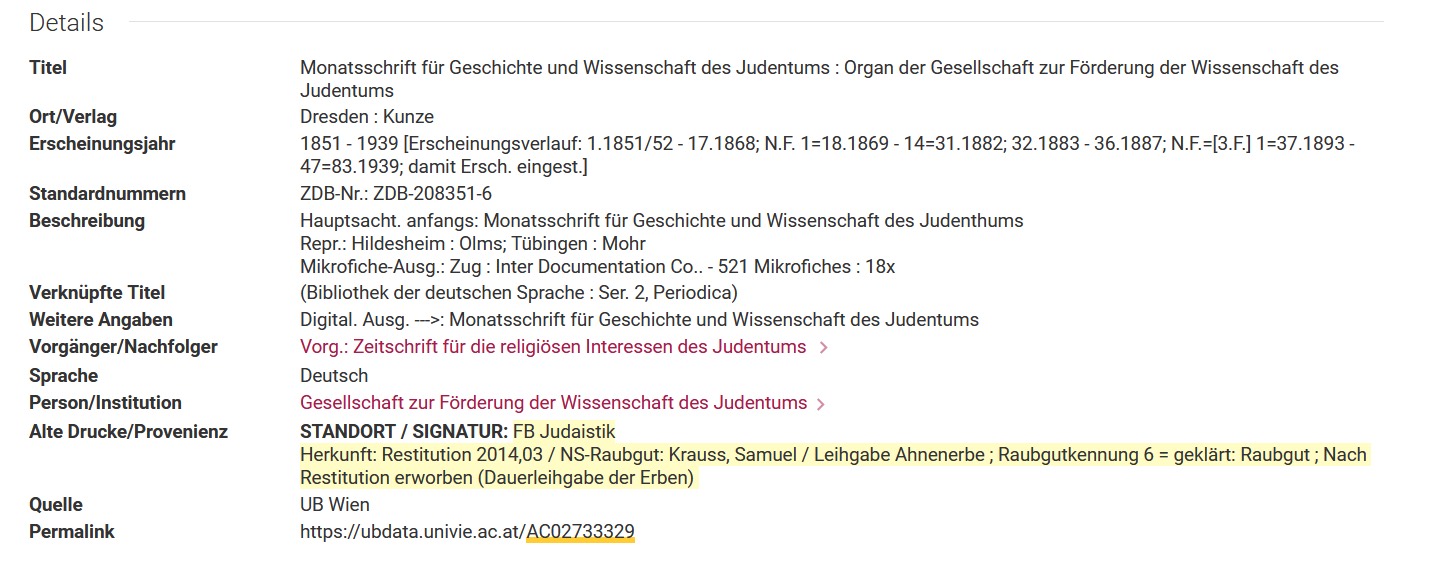
Excerpt from the catalog with the information about the restitution and the loan of the heirs © Markus Stumpf