Books |
Collection of Samuel Krauss
Author:
Markus Stumpf
Markus Stumpf
Nazi library looting
Although Krauss had received an offer from Cambridge University, his wife Josefa Irene (née Tedesco, 1872–1938) was seriously ill, and it was not until after her death in September 1938 that he joined his daughter Maria Heimberg (1899–1958) in Hamburg, where he prepared to leave for Great Britain. He was unable to take his huge library of over 3,000 books7 with him and left it in his locked apartment in Vienna.
Like the chief rabbi Israel Taglicht (1863–1943), he had lived at Ferdinandstraße 23 in the 2nd district, which also housed the main Jewish Community (IKG) library of over 33,000 books. In the opposite wing of the building in Tempelgasse was the Leopoldstadt Temple and also the extensive ITLA library with around 23,000 books.
While the IKG library was closed in March 1938 and forcibly taken over by Adolf Eichmann (1906–1962), head of the Central Office for Jewish Emigration from Vienna, on behalf of the Nazi regime, the ITLA library was taken away by the Gestapo in March/April 1938. The Leopold Temple burnt to the ground during the November Pogrom, and the IKG library was sealed by the Gestapo.8 The homes of rector Krauss and chief rabbi Taglicht were looted by the SS, SA and Gestapo, and the private libraries carted off. Edith Morgenstern (1896–1976), Samuel Krauss’s daughter later stated:
“I was present and witnessed this looting. There were two open trucks, at least four or six men in Nazi uniform brought all these books down from the libraries and loaded them. […] I saw the looted apartments of my father and chief rabbi Dr Taglicht. They were in great disarray, and the furniture was broken. Nothing was left […] of my father’s library.”9
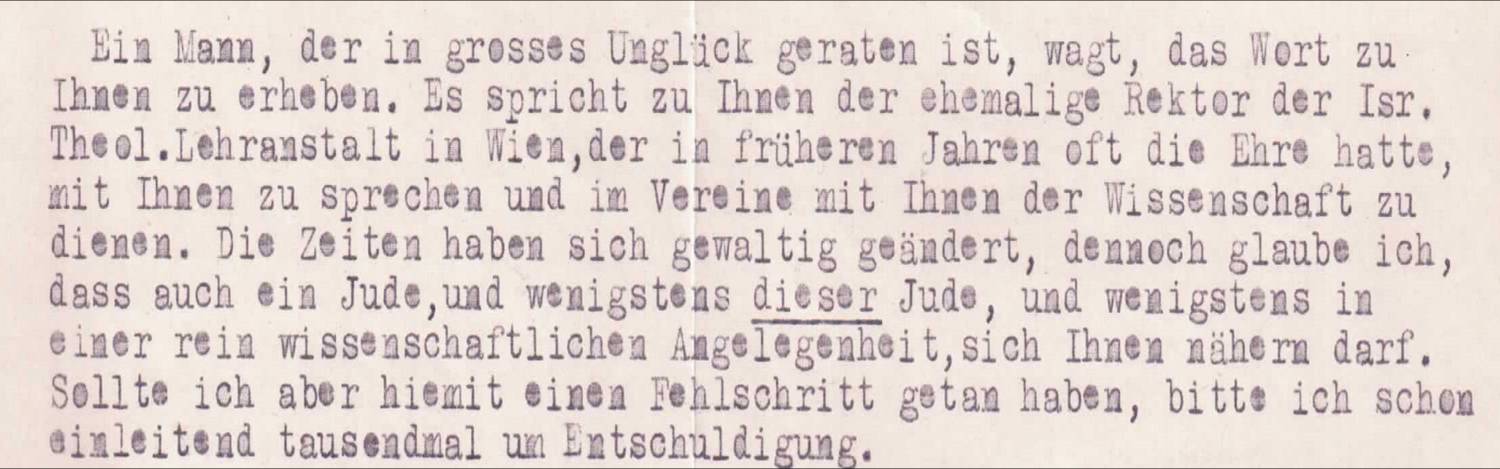
Worried about his library, which Cambridge University – where he was to function “for a small amount” as “adviser to the scholars and students in the Department of Near Eastern Studies” – had agreed to install, Krauss wrote in late November 1938 from Hamburg to Viktor Christian (1885–1963), new provisional dean of the Philosophy Faculty at the University of Vienna, whom he had known for many years as a fellow scholar.
Viktor Christian obtained his habilitation in 1922 in the Philosophy Faculty of the University of Vienna on Semitic, particularly cuneiform, writings. He was appointed extraordinary professor in 1924 and six years later ordinary professor of ancient Semitic philology and Middle Eastern archaeology. He was a member of the Bärenhöhle [bear’s cave],[10] an antisemitic network of professors seeking to prevent the appointment and habilitation of Jewish and/or left-wing academics at the University of Vienna. He applied to join the NSDAP in 1933 and was dismissed for his National Socialist activities a year later. No doubt as a result of the July agreement, he was rehabilitated and worked again as a professor from 1936. In May 1938 he applied once again to join the NSDAP and from November became a member of the SS, ending up in 1943 with the rank of SS‑Sturmbannführer.
Following the annexation, Christian became involved in academic policy in various functions – particularly as dean of the Philosophy Faculty of the University of Vienna until 1943, president of the Anthropology Society in Vienna (AGW) until 1945 and from April 1938 to January 1940 director of the Ethnology Department of the University of Vienna and head of the SS Ahnenerbe (ancestral heritage) department. He was admitted to the Academy of Sciences in Vienna in 1938. After resigning as dean, he was prorector from 1943 until the beginning of 1945 and in spring 1945 the last rector of the University of Vienna during the Nazi period.11
It was to this person that Samuel Krauss turned in an attempt to recover his library.
“Immediately after the new order, the valuable library at the said institute [the ITLA] was cleared and the library closed and dismantled. However painful that was for me, I was not personally affected. Then came the terrible days in November for the Jews. I believe it was on 12 November that in building II at Ferdinandstr. 23, which belonged to the Jewish Community, the community library [note: the IKG library was sealed during the pogrom and transported to Berlin in 1939 or 1941, depending on the source consulted], then the chief rabbi’s library in the same building and finally my own library were removed. The same thing happened to the two libraries on the other side of the temple building. I assume that no attention was paid to the fact that my library was my own private property and that it was due to the fact that it was close to the other libraries that it was removed. I am writing to you, professor, in this matter with the respectful and trusting request that you intervene.
I have no need to tell you as a scholar and researcher what the loss of a cherished and carefully compiled library signifies. Added to this is the fact that a large amount of academic material, some of it in my own works and articles, some in the form of unfinished handwritten works and articles and a huge amount of correspondence, was also probably taken. These things, which are of little significance to anyone besides myself, have no doubt been destroyed.
Without boasting, I think I can claim that this is also a threat for scholars in general and the Middle Eastern department under your outstanding direction in particular. That is why I make so bold as to appeal to you for assistance. You actions will not be for me or the Jews, but for the academic world in general.”12
Although his library was to be installed at Cambridge University, which had already protested in vain against its destruction, Krauss continued:
“I have no objection to my library remaining in the German Reich, but I would make the following condition or request: first, that my library is not destroyed but stored in its entirety at a suitable site; secondly, that the items containing handwritten notes and handwritten manuscripts in preparation for works or articles are returned to me; and thirdly, that my son’s property, which can be easily identified, is returned to him.
Professor, I must apologise again for bothering you with this matter. As a Middle Eastern scholar I would appreciate it if you were to intervene with the appropriate authority and point out the danger of losing valuable and irreplaceable items. […] I assume that you will not be taking any risks with these steps but rather that you will have the satisfaction of knowing that you are preventing a great misfortune and injustice.”13
Christian wrote back to Krauss just three days later and promised to attempt to “determine which authority seized your books and to pass on your request to it.”14 Krauss wrote again to Christian from Hamburg in mid-December to ask about the situation.15 There is no record of a reply, but Krauss’s books were extremely useful for the research activities of the head of the teaching and research section for the Near East of the SS Ahnenerbe, and in late January 1939 SS‑Sturmbahnführer Dr Fritz Polte requested information about the whereabouts of the Krauss library. Selectively paraphrasing Krauss and twisting the conditions mentioned by him, he wrote: “S. Krauss has agreed to his library remaining in the German Reich but understandably requests that it be stored in its entirety at a suitable site”.16 Christian naturally regarded the Department of Near Eastern Studies at the University of Vienna as this “suitable site”, not least as he hoped “to attract an established Aryan Talmud researcher to Vienna”. He concluded his letter by asking whom he should consult with regard to the allocation of the library to him.17 By chance, Christian had already found the right person, because Polte replied to him in February 1939 that “we are already attempting to reorganize and consolidate the library of the Jew Samuel Kraus[s], which became disorganized as a result of the urgent measures taken at the time. […] I cannot at present say what will happen to the library but I will attempt at all events to ensure that the Department is taken into account when Jewish material arrives.”18
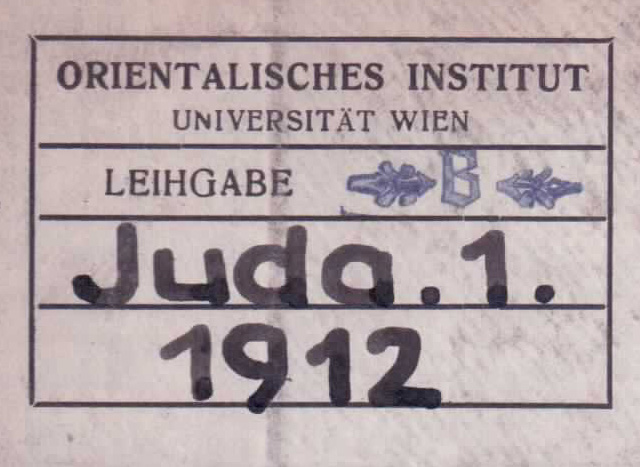
In August 1939, Christian was informed that “the books stored here on Jewish history and theology will be loaned” to the Department of Near Eastern Studies at the University of Vienna and could be collected at any time from the office at Spiegelgasse 1 in the 1st district.19 Christian authorized the librarian and assistant Karl Ammer (1911–1970) to collect the books from Samuel Krauss made available to the Department.20 The surviving list21 contains 226 books22 accepted by the Department from the SS-Ahnenerbe as “loan B”. Most of Krauss’s library was probably transported to Berlin with the majority of the IKG library and lost without a trace or possibly destroyed in the fire at the Reich Security Main Office building on 22 and 23 November 1943.
back
Although Krauss had received an offer from Cambridge University, his wife Josefa Irene (née Tedesco, 1872–1938) was seriously ill, and it was not until after her death in September 1938 that he joined his daughter Maria Heimberg (1899–1958) in Hamburg, where he prepared to leave for Great Britain. He was unable to take his huge library of over 3,000 books7 with him and left it in his locked apartment in Vienna.
Like the chief rabbi Israel Taglicht (1863–1943), he had lived at Ferdinandstraße 23 in the 2nd district, which also housed the main Jewish Community (IKG) library of over 33,000 books. In the opposite wing of the building in Tempelgasse was the Leopoldstadt Temple and also the extensive ITLA library with around 23,000 books.
While the IKG library was closed in March 1938 and forcibly taken over by Adolf Eichmann (1906–1962), head of the Central Office for Jewish Emigration from Vienna, on behalf of the Nazi regime, the ITLA library was taken away by the Gestapo in March/April 1938. The Leopold Temple burnt to the ground during the November Pogrom, and the IKG library was sealed by the Gestapo.8 The homes of rector Krauss and chief rabbi Taglicht were looted by the SS, SA and Gestapo, and the private libraries carted off. Edith Morgenstern (1896–1976), Samuel Krauss’s daughter later stated:
“I was present and witnessed this looting. There were two open trucks, at least four or six men in Nazi uniform brought all these books down from the libraries and loaded them. […] I saw the looted apartments of my father and chief rabbi Dr Taglicht. They were in great disarray, and the furniture was broken. Nothing was left […] of my father’s library.”9
Worried about his library, which Cambridge University – where he was to function “for a small amount” as “adviser to the scholars and students in the Department of Near Eastern Studies” – had agreed to install, Krauss wrote in late November 1938 from Hamburg to Viktor Christian (1885–1963), new provisional dean of the Philosophy Faculty at the University of Vienna, whom he had known for many years as a fellow scholar.
The beginning of the letter from Samuel Krauss to Viktor Christian © Vienna University Library
Viktor Christian obtained his habilitation in 1922 in the Philosophy Faculty of the University of Vienna on Semitic, particularly cuneiform, writings. He was appointed extraordinary professor in 1924 and six years later ordinary professor of ancient Semitic philology and Middle Eastern archaeology. He was a member of the Bärenhöhle [bear’s cave],[10] an antisemitic network of professors seeking to prevent the appointment and habilitation of Jewish and/or left-wing academics at the University of Vienna. He applied to join the NSDAP in 1933 and was dismissed for his National Socialist activities a year later. No doubt as a result of the July agreement, he was rehabilitated and worked again as a professor from 1936. In May 1938 he applied once again to join the NSDAP and from November became a member of the SS, ending up in 1943 with the rank of SS‑Sturmbannführer.
Following the annexation, Christian became involved in academic policy in various functions – particularly as dean of the Philosophy Faculty of the University of Vienna until 1943, president of the Anthropology Society in Vienna (AGW) until 1945 and from April 1938 to January 1940 director of the Ethnology Department of the University of Vienna and head of the SS Ahnenerbe (ancestral heritage) department. He was admitted to the Academy of Sciences in Vienna in 1938. After resigning as dean, he was prorector from 1943 until the beginning of 1945 and in spring 1945 the last rector of the University of Vienna during the Nazi period.11
It was to this person that Samuel Krauss turned in an attempt to recover his library.
“Immediately after the new order, the valuable library at the said institute [the ITLA] was cleared and the library closed and dismantled. However painful that was for me, I was not personally affected. Then came the terrible days in November for the Jews. I believe it was on 12 November that in building II at Ferdinandstr. 23, which belonged to the Jewish Community, the community library [note: the IKG library was sealed during the pogrom and transported to Berlin in 1939 or 1941, depending on the source consulted], then the chief rabbi’s library in the same building and finally my own library were removed. The same thing happened to the two libraries on the other side of the temple building. I assume that no attention was paid to the fact that my library was my own private property and that it was due to the fact that it was close to the other libraries that it was removed. I am writing to you, professor, in this matter with the respectful and trusting request that you intervene.
I have no need to tell you as a scholar and researcher what the loss of a cherished and carefully compiled library signifies. Added to this is the fact that a large amount of academic material, some of it in my own works and articles, some in the form of unfinished handwritten works and articles and a huge amount of correspondence, was also probably taken. These things, which are of little significance to anyone besides myself, have no doubt been destroyed.
Without boasting, I think I can claim that this is also a threat for scholars in general and the Middle Eastern department under your outstanding direction in particular. That is why I make so bold as to appeal to you for assistance. You actions will not be for me or the Jews, but for the academic world in general.”12
Although his library was to be installed at Cambridge University, which had already protested in vain against its destruction, Krauss continued:
“I have no objection to my library remaining in the German Reich, but I would make the following condition or request: first, that my library is not destroyed but stored in its entirety at a suitable site; secondly, that the items containing handwritten notes and handwritten manuscripts in preparation for works or articles are returned to me; and thirdly, that my son’s property, which can be easily identified, is returned to him.
Professor, I must apologise again for bothering you with this matter. As a Middle Eastern scholar I would appreciate it if you were to intervene with the appropriate authority and point out the danger of losing valuable and irreplaceable items. […] I assume that you will not be taking any risks with these steps but rather that you will have the satisfaction of knowing that you are preventing a great misfortune and injustice.”13
Christian wrote back to Krauss just three days later and promised to attempt to “determine which authority seized your books and to pass on your request to it.”14 Krauss wrote again to Christian from Hamburg in mid-December to ask about the situation.15 There is no record of a reply, but Krauss’s books were extremely useful for the research activities of the head of the teaching and research section for the Near East of the SS Ahnenerbe, and in late January 1939 SS‑Sturmbahnführer Dr Fritz Polte requested information about the whereabouts of the Krauss library. Selectively paraphrasing Krauss and twisting the conditions mentioned by him, he wrote: “S. Krauss has agreed to his library remaining in the German Reich but understandably requests that it be stored in its entirety at a suitable site”.16 Christian naturally regarded the Department of Near Eastern Studies at the University of Vienna as this “suitable site”, not least as he hoped “to attract an established Aryan Talmud researcher to Vienna”. He concluded his letter by asking whom he should consult with regard to the allocation of the library to him.17 By chance, Christian had already found the right person, because Polte replied to him in February 1939 that “we are already attempting to reorganize and consolidate the library of the Jew Samuel Kraus[s], which became disorganized as a result of the urgent measures taken at the time. […] I cannot at present say what will happen to the library but I will attempt at all events to ensure that the Department is taken into account when Jewish material arrives.”18
In August 1939, Christian was informed that “the books stored here on Jewish history and theology will be loaned” to the Department of Near Eastern Studies at the University of Vienna and could be collected at any time from the office at Spiegelgasse 1 in the 1st district.19 Christian authorized the librarian and assistant Karl Ammer (1911–1970) to collect the books from Samuel Krauss made available to the Department.20 The surviving list21 contains 226 books22 accepted by the Department from the SS-Ahnenerbe as “loan B”. Most of Krauss’s library was probably transported to Berlin with the majority of the IKG library and lost without a trace or possibly destroyed in the fire at the Reich Security Main Office building on 22 and 23 November 1943.
Label with stamp of the loan „B“ © Vienna University Library
7 Evelyn Adunka, Der Raub der Bücher (Vienna 2002 (= Bibliothek des Raubes 9), p. 226.
8 Ingo Zechner, “Die Bibliothek der Israelitischen Kultusgemeinde Wien”, in Murray G. Hall, Christina Köstner, Margot Werner, eds, Geraubte Bücher: Die Österreichische Nationalbibliothek stellt sich ihrer NS-Vergangenheit (Vienna 2004), pp. 82–103.
9 Wiedergutmachungsämter von Berlin, Rückerstattungssache Samuel Krauss, 54 WGA 5383/57, 08.11.1960, quoted from Adunka, Raub, pp. 22526.
10 Klaus Taschwer, Hochburg des Antisemitismus: Der Niedergang der Universität Wien im 20. Jahrhundert (Vienna 2015).
11 Markus Stumpf, “Viktor Christian”, in Lexicon of Austria Provenance Research. https://www.lexikon-provenienzforschung.org/en/christian-viktor; for details see Andre Gingrich: “Viktor Christian und die Völkerkunde in Wien 1938–1945: Universität, Anthropologische Gesellschaft und Akademie der Wissenschaften”, pp. 373–423, and Andre Gingrich, “Völkerkundliche Geheim-Expertise und Lagerforschung: Die Wiener ‘Lehr- und Forschungsstätte für den Vorderen Orient’ im SS-Ahnenerbe, pp. 1217–301), in Andre Gingrich, Peter Rohrbacher, eds, Völkerkunde zur NS-Zeit aus Wien (1938–1945) (Vienna 2021), 3 vols. (= Philosophisch-Historische Klasse Sitzungsberichte 913; Veröffentlichungen zur Sozialanthropologie 27); for the institutionalization of anti-Jewish research under Viktor Christian, see Dirk Rupnow, Judenforschung im Dritten Reich: Wissenschaft zwischen Politik, Propaganda und Ideologie (Baden- Baden 2011), esp. pp. 316–56.
12 Archiv der Universität Wien (AT-UAW)/Institut für Orientalistik, 1930–1970 (Bestand), Schachtel 60, Mappe Ahnenerbe, letter, Samuel Krauss an Viktor Christian, 25 November 1938.
13 Ibid.
14 Ibid., letter, Viktor Christian to Samuel Krauss, 28 November 1938.
15 Ibid., letter Samuel Krauss to Viktor Christian, 12 December 1938.
16 Ibid., letter, Viktor Christian to Dr. F. [Fritz] Polte, SS-Hauptsturmführer, 26 January 1939.
17 Ibid.
18 Ibid., letter, Fritz Polte, SS-Sturmbannführer, to Viktor Christian, 28 February 1939.
19 Ibid., letter, Sicherheitsdienst des Reichsführers-SS, SD-Unterabschnitt Wien, to Viktor Christian, 9 August 1939.
20 Ibid., letter Dekan Viktor Christian to Sicherheitsdienst des Reichsführers SS, SD – Unterabschnitt Wien, 16 August 1939.
21 Ibid., [list of titles].
22 The precise date of the handover is not known; including the handwritten items, the total increases to 229 books, although the date when the handwritten checks were made on the list is not known.
8 Ingo Zechner, “Die Bibliothek der Israelitischen Kultusgemeinde Wien”, in Murray G. Hall, Christina Köstner, Margot Werner, eds, Geraubte Bücher: Die Österreichische Nationalbibliothek stellt sich ihrer NS-Vergangenheit (Vienna 2004), pp. 82–103.
9 Wiedergutmachungsämter von Berlin, Rückerstattungssache Samuel Krauss, 54 WGA 5383/57, 08.11.1960, quoted from Adunka, Raub, pp. 22526.
10 Klaus Taschwer, Hochburg des Antisemitismus: Der Niedergang der Universität Wien im 20. Jahrhundert (Vienna 2015).
11 Markus Stumpf, “Viktor Christian”, in Lexicon of Austria Provenance Research. https://www.lexikon-provenienzforschung.org/en/christian-viktor; for details see Andre Gingrich: “Viktor Christian und die Völkerkunde in Wien 1938–1945: Universität, Anthropologische Gesellschaft und Akademie der Wissenschaften”, pp. 373–423, and Andre Gingrich, “Völkerkundliche Geheim-Expertise und Lagerforschung: Die Wiener ‘Lehr- und Forschungsstätte für den Vorderen Orient’ im SS-Ahnenerbe, pp. 1217–301), in Andre Gingrich, Peter Rohrbacher, eds, Völkerkunde zur NS-Zeit aus Wien (1938–1945) (Vienna 2021), 3 vols. (= Philosophisch-Historische Klasse Sitzungsberichte 913; Veröffentlichungen zur Sozialanthropologie 27); for the institutionalization of anti-Jewish research under Viktor Christian, see Dirk Rupnow, Judenforschung im Dritten Reich: Wissenschaft zwischen Politik, Propaganda und Ideologie (Baden- Baden 2011), esp. pp. 316–56.
12 Archiv der Universität Wien (AT-UAW)/Institut für Orientalistik, 1930–1970 (Bestand), Schachtel 60, Mappe Ahnenerbe, letter, Samuel Krauss an Viktor Christian, 25 November 1938.
13 Ibid.
14 Ibid., letter, Viktor Christian to Samuel Krauss, 28 November 1938.
15 Ibid., letter Samuel Krauss to Viktor Christian, 12 December 1938.
16 Ibid., letter, Viktor Christian to Dr. F. [Fritz] Polte, SS-Hauptsturmführer, 26 January 1939.
17 Ibid.
18 Ibid., letter, Fritz Polte, SS-Sturmbannführer, to Viktor Christian, 28 February 1939.
19 Ibid., letter, Sicherheitsdienst des Reichsführers-SS, SD-Unterabschnitt Wien, to Viktor Christian, 9 August 1939.
20 Ibid., letter Dekan Viktor Christian to Sicherheitsdienst des Reichsführers SS, SD – Unterabschnitt Wien, 16 August 1939.
21 Ibid., [list of titles].
22 The precise date of the handover is not known; including the handwritten items, the total increases to 229 books, although the date when the handwritten checks were made on the list is not known.
back