Fortepiano |
Object from Frida Gerngross
alias Maria Gardi
Author:
Monika Löscher
Monika Löscher
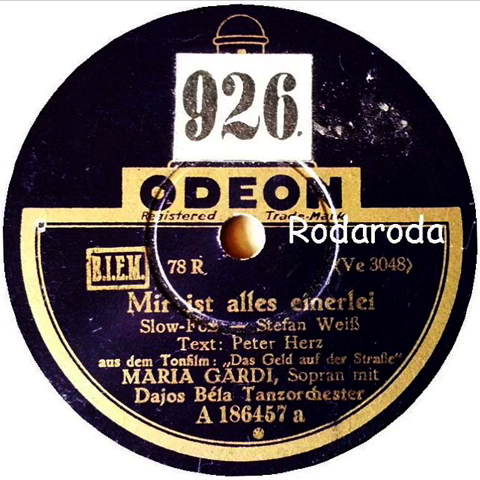
„Mir ist alles einerlei“
The song “Mir ist alles einerlei” comes from the 1930 comedy film Geld auf der Straße directed by Georg Jacoby (1882–1964). The same year he filmed the better-known comedy Pension Schöller, written by his father Wilhelm Jacoby (1855–1925) in 1890. Geld auf der Straße is the first Austrian feature film of the talkie era and starred public favourites such as Rosa Albach-Retty (1874–1980), Hans Moser (1880–1964), Hugo Thiemig (1854–1944) and his son Hans Thiemig (1900–1991). It also marked the debut of one Hedwig Kiesler (1914–2000), the future Hedy Lamarr.1 The catchy music to Geld auf der Straße was written by Stephan Weiß (1899–1984), a popular 1930s songwriter. 2
“Mir ist alles einerlei, ganz einerlei, wer wird das Leben denn so tragisch nehmen. Ob ich Geld hab oder keins, ist alles eins, deswegen brauch ich doch mich nicht zu schämen. Heute ist das Glück bei mir und morgen anderswo […], das Leben ist nun einmal so […]”,[3] Maria Gardi sang in 1930. But why are we talking about Maria Gardi today, and what does she have to do with provenance research in the Kunsthistorisches Museum?
The answer to this question can be found in a well-known publicity slogan from 1936:
“Es gibt nur an Steffl, es gibt nur a Wien, es gibt nur an Gerngross und dort gehn wir hin.”4
Maria Gardi was the stage name of Frida Gerngross. Under this pseudonym she devoted herself to her great passion, namely art. Frida (1885–1942) was the wife of Robert Gerngross (1878–1942), who with his siblings managed the Gerngross department store on Mariahilfer Strasse in Vienna, founded in 1879 by his father Alfred (1844–1908) and uncle Hugo (1838–1929).
The Gerngross family came originally from Forth near Nuremberg. Alfred began as a trainee at Herzmansky, another well-known department store. Business flourished, and Gerngross became the largest department store in Vienna and ultimately in the entire monarchy. From 1902 to 1904 the architects Fellner & Helmer, known above all for their theatres and concert houses, built a modern five-storey building for Gerngross. 5 Escalators, which had recently been invented – the Vienna Hausfrauen-Zeitung described them in awe in 1904 as “rolling carpets” 6 – were an absolute sensation and attracted even more admiring shoppers to the store. 7 The imposing architecture with its galleries, grandiose staircases, glass domes and oriel windows turned shopping into an experience in its own right. Looking at the historical photos of the interior, it is easy to understand why it was referred to as a “palace of fashion”. 8 Visitors could enjoy afternoon tea in the cafeteria, and there was live music every afternoon. 9 It is not surprising that the store was lauded as a “sight of Vienna” and “meeting place for all visitors”.10 In short, Gerngross was the forerunner of modern shopping malls, only much more elegant and refined.
But already in the early 1930s, Gerngross was the target of politically motivated assaults by National Socialists on account of its owners’ Jewish origins. There was even an attack with tear gas and stink bombs on the shopping Sunday just before Christmas 1932. Panic broke out among the shoppers in the crowded store and there were injuries. 11 After the annexation of Austria to the German Reich in 1938, the Gerngross department store was “Aryanized” and renamed Kaufhaus der Wiener – Ludwig & Co. 12 Some members of the Gerngross family managed to emigrate, but not all of them succeeded in escaping.
Author: Monika Löscher, provenance researcher
back
The song “Mir ist alles einerlei” comes from the 1930 comedy film Geld auf der Straße directed by Georg Jacoby (1882–1964). The same year he filmed the better-known comedy Pension Schöller, written by his father Wilhelm Jacoby (1855–1925) in 1890. Geld auf der Straße is the first Austrian feature film of the talkie era and starred public favourites such as Rosa Albach-Retty (1874–1980), Hans Moser (1880–1964), Hugo Thiemig (1854–1944) and his son Hans Thiemig (1900–1991). It also marked the debut of one Hedwig Kiesler (1914–2000), the future Hedy Lamarr.1 The catchy music to Geld auf der Straße was written by Stephan Weiß (1899–1984), a popular 1930s songwriter. 2
“Mir ist alles einerlei, ganz einerlei, wer wird das Leben denn so tragisch nehmen. Ob ich Geld hab oder keins, ist alles eins, deswegen brauch ich doch mich nicht zu schämen. Heute ist das Glück bei mir und morgen anderswo […], das Leben ist nun einmal so […]”,[3] Maria Gardi sang in 1930. But why are we talking about Maria Gardi today, and what does she have to do with provenance research in the Kunsthistorisches Museum?
The answer to this question can be found in a well-known publicity slogan from 1936:
“Es gibt nur an Steffl, es gibt nur a Wien, es gibt nur an Gerngross und dort gehn wir hin.”4
Maria Gardi was the stage name of Frida Gerngross. Under this pseudonym she devoted herself to her great passion, namely art. Frida (1885–1942) was the wife of Robert Gerngross (1878–1942), who with his siblings managed the Gerngross department store on Mariahilfer Strasse in Vienna, founded in 1879 by his father Alfred (1844–1908) and uncle Hugo (1838–1929).
The Gerngross family came originally from Forth near Nuremberg. Alfred began as a trainee at Herzmansky, another well-known department store. Business flourished, and Gerngross became the largest department store in Vienna and ultimately in the entire monarchy. From 1902 to 1904 the architects Fellner & Helmer, known above all for their theatres and concert houses, built a modern five-storey building for Gerngross. 5 Escalators, which had recently been invented – the Vienna Hausfrauen-Zeitung described them in awe in 1904 as “rolling carpets” 6 – were an absolute sensation and attracted even more admiring shoppers to the store. 7 The imposing architecture with its galleries, grandiose staircases, glass domes and oriel windows turned shopping into an experience in its own right. Looking at the historical photos of the interior, it is easy to understand why it was referred to as a “palace of fashion”. 8 Visitors could enjoy afternoon tea in the cafeteria, and there was live music every afternoon. 9 It is not surprising that the store was lauded as a “sight of Vienna” and “meeting place for all visitors”.10 In short, Gerngross was the forerunner of modern shopping malls, only much more elegant and refined.
But already in the early 1930s, Gerngross was the target of politically motivated assaults by National Socialists on account of its owners’ Jewish origins. There was even an attack with tear gas and stink bombs on the shopping Sunday just before Christmas 1932. Panic broke out among the shoppers in the crowded store and there were injuries. 11 After the annexation of Austria to the German Reich in 1938, the Gerngross department store was “Aryanized” and renamed Kaufhaus der Wiener – Ludwig & Co. 12 Some members of the Gerngross family managed to emigrate, but not all of them succeeded in escaping.
Author: Monika Löscher, provenance researcher
1 Armin Loacker, Anschluss im 3/4-Takt – Filmproduktion und Filmpolitik in Österreich 1930–1938 (Trier 1999), p. 2.
2 https://de.wikipedia.org/wiki/Geld_auf_der_Stra%C3%9Fe; Wiener Zeitung, 12 November 1930, p. 7.
3 “I don’t care, not at all, who takes life so seriously? I don’t care whether I have money or not. I’m not ashamed of it. Today I’m the lucky one, tomorrow someone else […] That’s just the way life is.”
4 “There’s only one Steffl [St Stephen’s Cathedral], there’s only one Vienna, there’s only one Gerngross, and that’s where we’re going” – Kaufhaus Gerngross poster, Vienna 1936, in Andreas Lehne, “From the Haas House to Gerngross: Highlights of Viennese department store architecture”, in Astrid Peterle, ed., Buy from Jews! Story of a Viennese Store Culture (Vienna 2017), pp. 150–63, here p. 158.
5 Roman Sandgruber, “The age of the department store”, in Peterle, ed., Buy from Jews!, pp. 36–53; Christine Maria Wiesner, “Auf dem Weg in die Moderne: Die Wiener Warenhäuser 1863–1918”, diss., Vienna 2013, http://othes.univie.ac.at/25217/1/2013-01-23_0547159.pdf.
6 Wiener Hausfrauen-Zeitung, 1904, p. 445.
7 Peter Payer, “Wenn der Handlauf mitreist”, in Die Presse: Spectrum, 3 December 2016, https://www.nextroom.at/article.php?id=41504.
8 Das interessante Blatt, 16 December 1909, p. 11.
9 Neues Wiener Tagblatt (day edition), 8 October 1911, p. 108.
10 The advertisement in the programme Das Mirakel, 15 September – 3 October 1912, Vienna Rotunde.
11 Wiener Montagsblatt, 19 December 1932, pp. 1–2.
2 https://de.wikipedia.org/wiki/Geld_auf_der_Stra%C3%9Fe; Wiener Zeitung, 12 November 1930, p. 7.
3 “I don’t care, not at all, who takes life so seriously? I don’t care whether I have money or not. I’m not ashamed of it. Today I’m the lucky one, tomorrow someone else […] That’s just the way life is.”
4 “There’s only one Steffl [St Stephen’s Cathedral], there’s only one Vienna, there’s only one Gerngross, and that’s where we’re going” – Kaufhaus Gerngross poster, Vienna 1936, in Andreas Lehne, “From the Haas House to Gerngross: Highlights of Viennese department store architecture”, in Astrid Peterle, ed., Buy from Jews! Story of a Viennese Store Culture (Vienna 2017), pp. 150–63, here p. 158.
5 Roman Sandgruber, “The age of the department store”, in Peterle, ed., Buy from Jews!, pp. 36–53; Christine Maria Wiesner, “Auf dem Weg in die Moderne: Die Wiener Warenhäuser 1863–1918”, diss., Vienna 2013, http://othes.univie.ac.at/25217/1/2013-01-23_0547159.pdf.
6 Wiener Hausfrauen-Zeitung, 1904, p. 445.
7 Peter Payer, “Wenn der Handlauf mitreist”, in Die Presse: Spectrum, 3 December 2016, https://www.nextroom.at/article.php?id=41504.
8 Das interessante Blatt, 16 December 1909, p. 11.
9 Neues Wiener Tagblatt (day edition), 8 October 1911, p. 108.
10 The advertisement in the programme Das Mirakel, 15 September – 3 October 1912, Vienna Rotunde.
11 Wiener Montagsblatt, 19 December 1932, pp. 1–2.
back
https://youtu.be/3BSKC7-aW_o
from the film "Geld auf der Straße"
Maria Gardi (soprano) with the Dajós Bela Dance Orchestra